Future-oriented environment combining actual equipment and XR for
hands-on practice from semiconductor front-end to back-end processes
AI Article Summary
The expansion of XR education models and technological advancement are expected in conjunction with the government’s semiconductor talent development initiative.
MeshLink has installed the XR-based semiconductor education platform ‘Faraday XR’ at Seoul Semiconductor High School.
Students can repeatedly learn processes and equipment operation procedures in an XR environment, increasing the efficiency of practical training.

Meshlink, a company specializing in Extended Reality (XR) education, has set out to target the future semiconductor vocational education market by implementing the immersive semiconductor education platform ‘Faraday XR’ at Seoul Semiconductor High School.
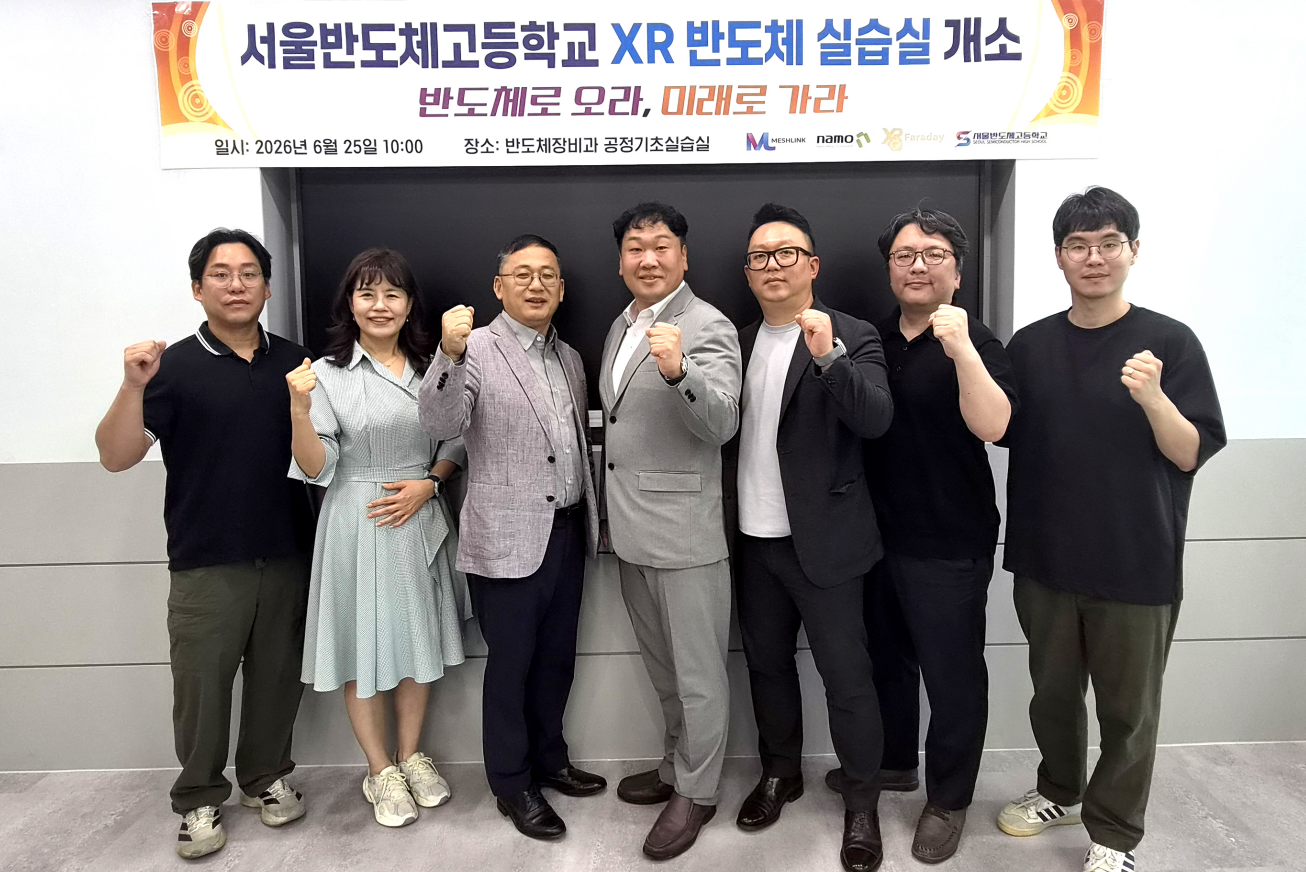
Meshlink announced on the 15th that it has established an XR-based semiconductor practice room at Seoul Semiconductor High School and recently held an opening ceremony.
This implementation is an example of a specialized semiconductor high school introducing an educational environment that combines XR technology with existing practice equipment, characterized by supporting students in repeatedly learning processes and equipment operation procedures before handling actual equipment.
‘Faraday XR,’ developed by Meshlink, is an immersive educational platform based on actual semiconductor manufacturing processes. Designed to allow for repeated practice of semiconductor front-end and back-end processes in an XR environment, it enables users to experience equipment operation, work procedures, and safety training in an environment similar to a real industrial site.
Seoul Semiconductor High School has been equipped with both the ‘Faraday XR S1’ for front-end process education and the ‘Faraday XR S2’ for back-end process education. Students will learn the entire semiconductor manufacturing process within a single curriculum, ranging from front-end processes such as cleaning, oxidation, deposition, photolithography, and etching to dicing, die bonding, wire bonding, packaging, and inspection.
MeshLink expects that by using the XR platform to enhance students’ understanding of the process before conducting practical training on actual equipment, it will be possible to reduce equipment misoperation and utilize limited training equipment more efficiently.
Recently, as the government expands semiconductor talent development initiatives such as the Semiconductor Specialized University Support Project, the Research and Education System (RISE), Glocal University 30, and specialized high schools through partnerships, interest in XR-based practical training environments is also rising. Meshlink anticipates that educational models combining actual equipment with XR will spread to universities and vocational high schools.
“XR is not intended to replace actual semiconductor equipment, but rather to serve as an educational platform that helps students practice with the equipment after fully understanding the processes and work procedures,” a Meshlink official said. “We plan to continue advancing our technology so that it can establish itself as a standard educational model for semiconductor educational institutions to strengthen repetitive practice and safety training.”
Busan = Reporter Yoon Il-seon news8282@kmib.co.kr
[Source] – Kukmin Ilbo
[Original Link] – https://www.kmib.co.kr/article/view.asp?arcid=0030113395&code=61141111&cp=nv
